English can be tricky, especially when words look almost identical but have entirely different meanings. One such pair that causes constant confusion is “lose” and “loose.” Although these two words differ by just one letter, that single “o” dramatically changes their meaning, pronunciation, and usage. Understanding the Lose and Loose Meaning can help improve your writing, avoid embarrassing mistakes, and refine your professional communication.
Why People Mix Up “Lose” and “Loose”
The confusion often starts with how the words sound. “Lose” is pronounced /luːz/, rhyming with “choose,” while “loose” is pronounced /luːs/, rhyming with “moose.” The difference in the final sound—“z” versus “s”—may seem subtle when spoken quickly, especially by non-native speakers.
Another reason people get mixed up is visual similarity. Both words share the same root letters but serve completely different grammatical roles:
“Lose” is a verb.
“Loose” is typically an adjective (though it can also be a verb in less common cases).
Once you understand that distinction, the Lose and Loose Meaning becomes much clearer.
The Meaning of “Lose”
Let’s start with lose. This word refers to failing to keep something, misplacing it, or not winning. In short, “lose” implies a state of deprivation or defeat.
Here are some examples to illustrate how “lose” is used:
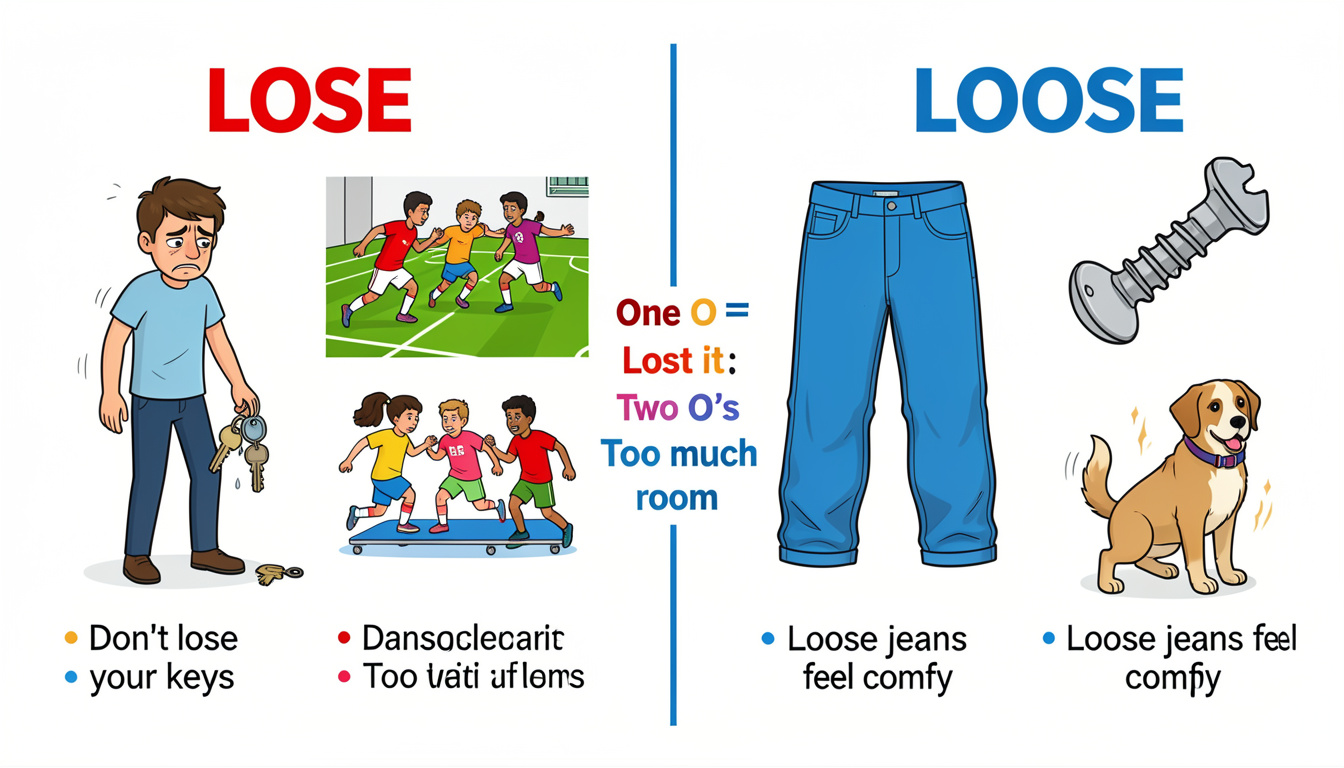
“Don’t lose your keys.” (To misplace something)
“They might lose the game if they’re not careful.” (To fail to win)
“He didn’t want to lose his temper.” (To cease control over emotions)
In each sentence, “lose” expresses the idea of lacking something previously possessed—whether it’s an object, victory, or composure. You can think of “losing” as a process of subtraction: when you lose, something is gone.
The Meaning of “Loose”
On the other hand, loose describes something not tight or securely attached. It can refer to physical objects or even abstract ideas like discipline or control.
Here are some common uses:
“The shirt is too loose.” (Not fitting tightly)
“He let the dog loose in the yard.” (Not restrained)
“The bolt came loose after years of wear.” (No longer firmly secured)
In comparison to “lose,” “loose” conveys freedom or lack of restriction, not loss. This small shift in meaning can create big differences in tone or comprehension. If you confuse the two, you could end up changing the entire message of your sentence.
For instance:
✅ Correct: “I don’t want to lose my wallet.”
❌ Incorrect: “I don’t want to loose my wallet.”
The wrong spelling makes the sentence nonsensical—it suggests you want to set free your wallet!
Simple Trick to Remember Lose and Loose Meaning
A practical way to remember the Lose and Loose Meaning is to think of the number of “o”s in each word:
“Lose” has one “o” — you might lose one thing.
“Loose” has two “o”s — imagine something stretched wide or open (like two loops), symbolizing looseness.
This visual connection helps many learners instantly recall which word fits their sentence. It’s simple but surprisingly effective.
Common Mistakes People Make
Even experienced writers sometimes confuse these words, especially in online communication where spelling slips can go unnoticed. Let’s look at a few typical errors and corrections:
Incorrect: Don’t loose focus!
Correct: Don’t lose focus!
Incorrect: My shoes are lose on my feet.
Correct: My shoes are loose on my feet.
Using these correctly reinforces professionalism and precision in writing. In business communication, such small errors can undermine credibility. That’s why understanding Lose and Loose Meaning is not just a grammar lesson—it’s a part of presenting yourself clearly and confidently.
“Loose” as a Verb — A Lesser-Known Usage
While “loose” mainly acts as an adjective, it can sometimes serve as a verb meaning “to release” or “set free.” This usage is much less common but worth noting.
Example:
“They loosed the arrows into the sky.”
Here, “loosed” means “let go” or “released.” It’s an older form, mostly found in literature and historical writing rather than everyday speech.
That nuance adds another layer to the Lose and Loose Meaning distinction: one word focuses on loss, while the other deals with freedom or letting go.
Why Getting It Right Matters
At first, confusing “lose” and “loose” may seem harmless, but it can lead to misunderstandings or make your writing appear careless. If you’re composing emails, articles, or marketing copy, these tiny differences influence how readers perceive your command of language.
Example for SEO writers:
If you’re describing clothing products and accidentally write “lose fit” instead of “loose fit,” customers might think you meant failure rather than comfort. Likewise, describing a campaign as “Don’t loose momentum” could sound unprofessional.
Professional writing demands clarity—and mastering the Lose and Loose Meaning helps you maintain that precision across all kinds of content.
Pronunciation Practice Helps
Non-native English speakers often benefit from practicing the pronunciation difference. Try saying:
“Lose” – /luːz/ (with a buzzing “z” sound)
“Loose” – /luːs/ (with a soft “s” sound)
You can amplify the distinction by exaggerating each ending sound during practice. Listening to native pronunciation through language apps or audiobooks reinforces the difference naturally over time.
Quick Reference Table
Word Part of Speech Meaning Example
Lose Verb To misplace, fail to win, or no longer have something “I don’t want to lose hope.”
Loose Adjective / Verb Not tight, not firmly fixed, or to release “The knot is loose.” / “She loosed her grip.”
Having this mental table makes the Lose and Loose Meaning comparison simple to recall whenever you write or edit your content.
Final Thoughts
Language mastery isn’t about memorizing endless grammar rules—it’s about noticing small patterns. “Lose” and “loose” may be only one letter apart, but that letter transforms both meaning and tone. To summarize:
“Lose” = to suffer loss or not keep something.
“Loose” = to be free, not tight, or unconfined.
By paying attention to those subtleties, your writing gains clarity and credibility. The next time you draft an email, compose a headline, or craft a blog post, take an extra second to confirm you’ve used the right word. It’s an easy habit that keeps your communication sharp and polished.
Mastering the Lose and Loose Meaning ensures you never lose confidence—or leave your grammar loose—again.